Chemical Reactivity through Rocket Engineering
Year 10 Project · 4 Weeks · NSW Stage 5 Science
Program in one paragraph
Year 10 students learn the four reaction types of the NSW Stage 5 Chemical World strand — synthesis, decomposition, displacement, neutralisation — together with rates of reaction, by designing a small copper combustion chamber for an ethanol or LPG rocket engine, validating the engineering through bench chemistry and a plastic 3D form study, then handing the design off to a professional vendor who fabricates and pressure-tests the copper part off-site. Students never share a postcode with anything that combines heat and pressure. They observe the off-site burn via video and reconcile measured data against their predictions. Five teams work in parallel under a shared Interface Control Document; every student produces four scaffolded lab reports.
The hard safety rule
Development of anything combining heat and pressure is fabricated and tested by a licensed professional firm. Students view firing trials by video at a safe distance only.
The school covers design, modelling, standard-concentration wet chemistry, plastic form-study fabrication, and atmospheric flame demonstration. The school does not develop pressurised combustion chambers any kind.
Phase architecture
Phase 0  ┃ FOUNDATION                           [School · W1]
Phase 1  ┃ LAB CHEMISTRY + PLASTIC FORM STUDY   [School · W2-3]
Phase 2  ┃ DIGITAL TWIN + VENDOR PROCUREMENT    [School + RFQ · W3-4]
Phase 3  ┃ OFF-SITE COPPER-ENGINE BURN          [Vendor · Post-W4]
Phase 4 ┃ RECONCILIATION + REPORTING [School · W4]| Phase | Venue | Article | Energy at venue | Student presence |
|---|---|---|---|---|
| 0 Foundation | School | (none) | (none) | Full participation |
| 1 Lab chemistry + form study | School fume cupboard + lab | Plastic Trotec chamber model + Cu coupons + Mg ribbon | Atmospheric only | Full participation |
| 2 Digital twin + procurement | School + vendor email | Rust prediction sheets + STEP file + RFQs to ≥3 vendors | None | Full participation |
| 3 Off-site copper-engine burn | Licensed vendor test cell | Copper chamber + ethanol or LPG + (± O₂ enrichment) | Pressurised, hot | None — video only at safe distance |
| 4 Reconciliation + reporting | School | Vendor telemetry CSV + prediction sheet | (analysis only) | Full participation |
Why this is a chemistry project
Each Stage 5 reaction type is covered by a focused lab during Phase 1. The rates and decomposition labs are deliberately rocket-relevant — catalysed H₂O₂ decomposition is the same chemistry that drove the Walter rocket (1937), the Me 163 Komet, the Bell Rocket Belt, and the X-1’s turbopump. Calorimetry on ethanol and methane combustion is the same chemistry that drove the F-1 and almost every liquid bipropellant.
| Reaction type | School-side lab | Rocket-context link |
|---|---|---|
| Synthesis | Ethanol and methane calorimetry — measure chemical power output (W) vs flow rate | The fuel reaction itself: C₂H₅OH + 3 O₂ → 2 CO₂ + 3 H₂O |
| Decomposition | H₂O₂ + KMnO₄ rates calibration — gas evolution rate vs [H₂O₂], [KMnO₄], T | Walter monopropellant rockets: 2 H₂O₂ → 2 H₂O + O₂ |
| Displacement | Galvanic series demo (Cu, Zn, Fe in CuSO₄) plus Mg + HCl pop test (H₂ identification) | Cu sits low on the activity series → safe in contact with combustion products |
| Neutralisation | HCl + NaOH titration with phenolphthalein | Conceptual: NASA pad water-spray neutralises NOₓ in exhaust |
| Rates of reaction | The H₂O₂/KMnO₄ calibration is the rates lab — three controlled-variable curves yield activation energy and catalyst behaviour | The rate the engine needs to run dictates the oxidiser supply |
The H₂O₂ teacher-demo / student-calibration split
Students run quantitative calibration curves at 3% and 6% H₂O₂ (drugstore-grade, low-hazard, suitable for Year 10 hands-on work). The teacher runs a single 35% H₂O₂ demonstration (school lab stock, teacher-only dispensing) — the same concentration class as a real peroxide monopropellant rocket.
The student-calibrated curve is extrapolated to predict the 35% rate. The teacher’s demonstration measures the actual 35% rate. Comparing the two is the lab’s headline reconciliation: “How well does our calibration model extrapolate?” — a real engineering question.
The stoichiometric question students answer themselves
Given the measured calibration curves, students compute whether 35% H₂O₂ at school-flow rates can in principle supply the O₂ for a 0.5 g/min ethanol burn. The calculation: 0.5 g/min ethanol needs ~730 mL/min O₂, which requires ~5.6 mL/min of 35% H₂O₂ (working: 1 mL of 35% peroxide → ~130 mL O₂ at STP). That’s a back-of-envelope answer that decides whether the project’s premise is feasible. The Computational Engineering team’s prediction sheet shows the same calculation with their own worked numbers.
Why copper
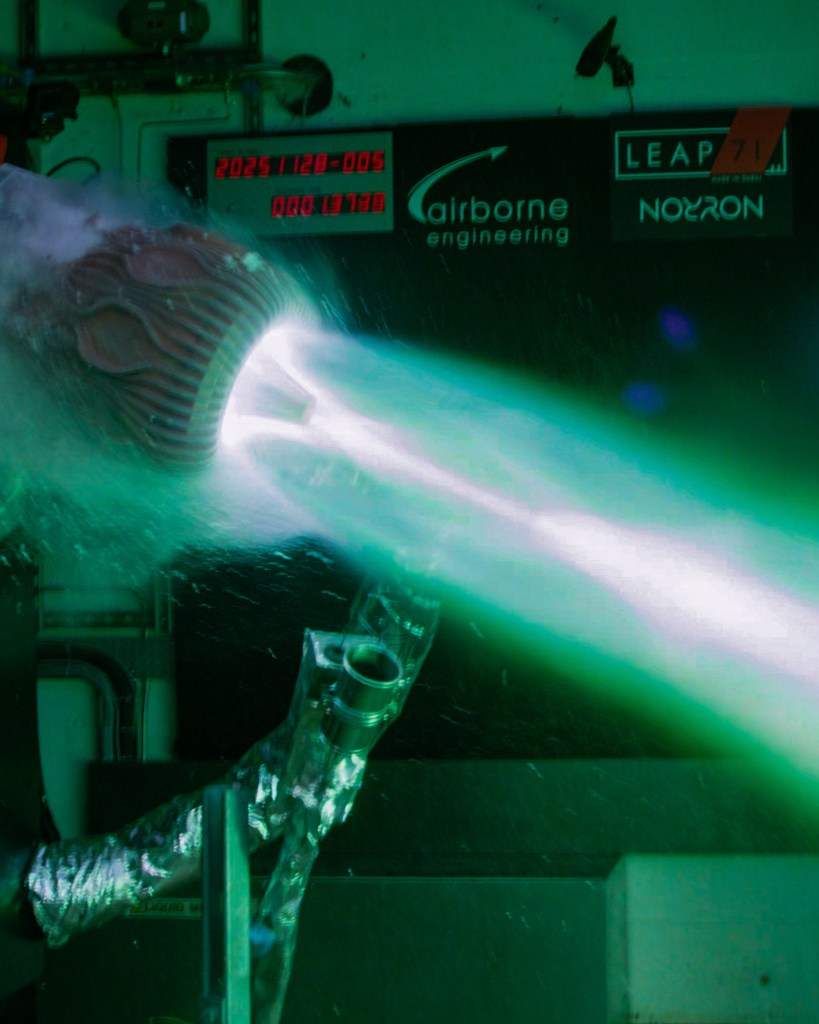
The Leap71 Insanity* aerospike — 3D-printed in copper as a single monolithic part. The fail-soft properties of copper that justify our chamber choice are the same properties that drove Leap71’s material selection.* Image © Leap71 · used here for educational reference
Copper is the rocket-engineering material of choice for a small combustion chamber because it fails soft:
- Melts at 1085 °C — well below adiabatic flame temperature of ethanol or LPG combustion, so worst-case is melt-and-leak rather than shrapnel fragmentation
- Ductile — deforms plastically before fracture; no high-strain-rate failure mode that releases stored elastic energy
- Highest thermal conductivity of any common metal (≈ 400 W/m·K, ~8× steel) — heat moves into the structure rather than building up at the hot face
- Leap71’s Insanity aerospike is 3D-printed copper for exactly these reasons — students see the same material choice for the same engineering reason in a current state-of-the-art engine
The vendor builds the chamber, not the school.
Two construction options for the copper chamber
The Manufacturing team produces an RFQ that asks vendors to quote on both construction approaches. The choice between them is the team’s procurement decision, defended in their final report.
Option H — Monolithic 3D-printed copper
Single copper part, additively manufactured, no joints, no interfaces. This is the Leap71 pattern — see https://youtu.be/B_IHf4Rkfk8.
- Pro: zero internal interfaces; cleanest thermal path; single vendor operation
- Con: ~$300-800 for a small part; only a handful of AU vendors print copper; longer lead time
Option L — Laminated 2D+1 stack
Multiple stamped or laser-cut copper layers, vendor-brazed into a sealed chamber. This is the 1940s cavity magnetron pattern — the Boot–Randall device that gave Britain centimetric radar was built exactly this way because monolithic machining of the complex internal cavity was beyond the state of the art.
- Pro: ~$80-200; far more vendors capable; shorter lead time; layers can be inspected before braze
- Con: interfacial thermal resistance between layers; vendor braze quality must be inspected; multiple operations
The trade-off the Manufacturing team gets to make. Both are vendor-built; both are copper; both are within the safety case.
Engineering principle the program teaches
Before you build a complex thing, build a minimum-viable model that exercises every interface. Phase 1 builds a plastic Trotec form study of the chamber. That artefact has no combustion role — it exists so that the team can prove the CAD model, check the fit of the injector, test the nozzle profile, and walk through assembly before asking a vendor for a quote on a metal part.
Same pattern aerospace primes use: cardboard mock-up → foam-board prototype → plastic FDM → SLM metal. Each step catches design errors at the cheapest possible cost.
The principle also has a second leg: the analyst is not the test engineer. The Computational Engineering team produces predictions before the vendor fires the engine, then reconciles measured vs predicted after. This is exactly how aerospace primes use their analyst groups. Students see — and live — that separation.
Five teams, ~6 students each
| Team | Owns | Key deliverable |
|---|---|---|
| Rocket Chemistry | Propellant choice, H₂O₂/KMnO₄ rates calibration, ethanol/methane calorimetry, titration | Three calibration curves + stoichiometric worked answer (does the chemistry feed the burn?) |
| Materials | Materials trade-study (Cu vs Al vs steel) + Cu justification | Materials specification for vendor |
| Manufacturing | CAD, Trotec form study, vendor RFQ + selection | Plastic form study + vendor selection memo |
| Computational Engineering (teacher-led) | Rust digital twin, predictions | Prediction sheets per design iteration |
| Heat Exchanger | Reconcile vendor telemetry against prediction | Residual analysis per delivered data set |
Each team has six internal roles (Lead, Deputy, Safety Officer, Build, Recorder, Analyst) to absorb absences. See team charters for full charters.
Schedule (12 student-facing lessons across 4 weeks)
W1  Foundation, safety, team formation
    L1  Project brief + safety induction + team allocation
    L2  Reaction types I — synthesis (ethanol/methane combustion observation) + decomposition (H₂O₂ + KMnO₄ demo at 3%)
    L3  Reaction types II — displacement (galvanic series Cu/Zn/Fe; Mg + HCl pop test) + neutralisation (HCl + NaOH titration)

W2  H₂O₂/KMnO₄ rates calibration + materials trade-study + Trotec form study
    L4  Rates of reaction concept + experimental design for the three H₂O₂ calibrations
    L5  H₂O₂/KMnO₄ rates calibration (3 experiments: [H₂O₂], [KMnO₄], temperature) + teacher 35% demonstration + reconciliation
    L6  Materials team starts Cu vs Al vs steel trade-study; Manufacturing produces v0.1 CAD
    L7  Design review #1 + Lab report 1 (rates + titration + reconciliation) due

W3  Calorimetry + plastic form study + atmospheric flame demo + vendor RFQ
    L8   Ethanol + methane calorimetry (water-bath calorimeter, chemical-power output curves)
    L9   Trotec cut + plastic form study assembled; cold-flow on plastic form study; injector + nozzle fit
    L10  Atmospheric LPG flame at form-study nozzle (Bunsen-class energy, instrumented)
         + stoichiometric worked answer (RC-D8: does H₂O₂ chemistry meet ethanol-burn O₂ demand?)
    L11  Vendor RFQs out to ≥3 candidates + Lab report 2 (calorimetry + form study + stoich) due

W4  Vendor selection, prediction sheet, reconciliation
    L12  Vendor quotes received; Manufacturing team evaluates;
         Comp Eng issues final prediction sheet for vendor burn;
         Vendor selection memo finalised + Lab report 3 (prediction) due;
         If vendor video is back — reconciliation. Otherwise Lab report 4 (reconciliation against
         predicted telemetry) written and submitted when vendor data arrives.
The vendor burn happens post-program on the vendor’s schedule. Students receive the telemetry CSV + video later; the reconciliation report can be written before or after the vendor data lands, depending on lead time.
Assessment
Four scaffolded lab reports + a team design-review presentation in L7. See lab-report-scaffold.qmd for structure. NSW Working Scientifically outcomes SC5-4WS to SC5-9WS are mapped explicitly per report; see syllabus-mapping.qmd.
A successful vendor burn is not a requirement for a passing grade. The grade is on design quality, data analysis, and report writing. This is communicated to students Day 1 so they iterate without fear.
Safety envelope
- Students run wet chemistry at standard school concentrations — 3% and 6% H₂O₂ for student calibration work; 1 M HCl; 1 M NaOH; standard Mg ribbon
- 35% H₂O₂ is in scope as a teacher-only demonstration (school lab stock; teacher-only dispensing; students at the 2 m line). This is the calibration point that anchors the student-measured extrapolation.
- Atmospheric LPG flame demo only — flashback arrestor mandatory
- Calorimetry on ethanol and methane combustion is standard Year 10 practice (water-bath + thermocouple)
- No flight testing — static off-site only
- Pressurised combustion: off-site, vendor-licensed test cell, video observation only
- Mixed-gas storage, hydrogen-as-fuel: out of scope
See safety-case.qmd for the full risk register and SOPs.
Budget
| Item | Cost (AUD) | Notes |
|---|---|---|
| Trotec consumables (PLA/acrylic) | $0–30 | School stock likely sufficient |
| Mg ribbon (pop test only), HCl, NaOH, phenolphthalein, KMnO₄, Cu/Zn/Fe coupons | School lab stock | Standard Stage 5 reagents |
| 3% and 6% H₂O₂ (student rates calibration) | School lab stock or drugstore | Drugstore-grade |
| 35% H₂O₂ (teacher demonstration only) | School lab stock, oxidiser cabinet | Already on-site; teacher-only handling |
| Ethanol (calorimetry), methane (gas tap) | School lab stock | Standard |
| K-type TC + water-bath calorimeter rig | School stock or ~$60 buy | Standard Year 10 calorimetry equipment |
| Brass plumbing for LPG demo (insurance) | $40 | One-time Bunnings run |
| Vendor copper chamber (Option H monolithic) | $300–800 | Quote-driven |
| Vendor copper chamber (Option L laminated) | $80–200 | Quote-driven |
| Vendor pressure-test fee (Phase 3 burn) | TBD, typically $200–500 | Quote-driven, parent contribution if needed |
| Total exposure | ~$120–1300 | Range covers both construction options + test fees |
The vendor cost is the program’s main budget unknown until quotes come back. The Manufacturing team’s vendor-selection memo defends the choice including cost-vs-pedagogical-value rationale.
Documents in this package
program-overview.qmd— this fileinterface-control-document.qmd— interfaces between teamssafety-case.qmd— risk register + SOPs per rigphase-transition-gate.yaml— Phase 2 → Phase 3 vendor handover gatecomputational-engineering-static-test.qmd— interactive 3D viewer + digital twinteam-charters/— one charter per teamlab-report-scaffold.qmd— reused four timessyllabus-mapping.qmd— NSW Stage 5 outcome traceabilitylesson-packs/W*L*/— per-lesson eduKG packs
Status
This document set is in DRAFT. The full program runs after:
- HoD Science sign-off on the safety case
- WHS Officer sign-off on the at-school chemistry experiments
- Vendor selected (Manufacturing team deliverable in W4)
- Parent communication of the off-site / video-only observation model