Reactivity Rocket Project
Year 10 Chemistry · 4 weeks · NSW Stage 5 Science
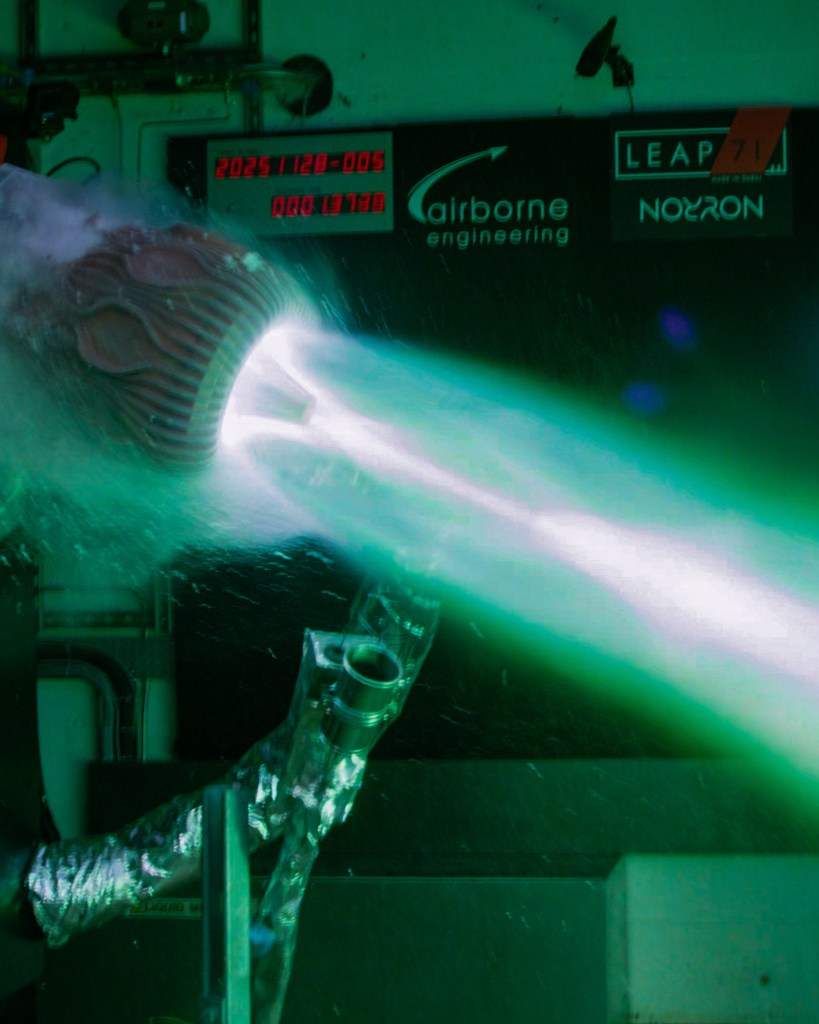
Leap71 Insanity* aerospike — 3D-printed monolithic copper.* Image © Leap71 · used here for educational reference
Project package
Year 10 students learn the four reaction types of the NSW Stage 5 Chemical World strand — synthesis, decomposition, displacement, neutralisation — together with rates of reaction, by designing a small copper combustion chamber for an ethanol or LPG rocket engine. The actual pressurised burn is fabricated and tested off-site by a licensed vendor; students observe by video at a safe distance only.
The hard safety rule: Anything combining heat and pressure is done by a licensed professional firm. Students never share a postcode with pressurised combustion.
This site is the working documentation set. Everything here is in DRAFT.
Read in this order
- Program Overview — phase architecture and why
- Interface Control Document — contracts between teams
- Safety Case — risk register + SOPs (needs HoD + WHS sign-off)
- Phase Transition Gate — vendor handover gate (YAML)
- Computational Engineering Static Test — interactive 3D viewer + digital twin
- Lab Report Scaffold — the report structure students follow four times
- Syllabus Mapping — NSW Stage 5 outcome traceability
Team charters
Each team has its own charter with mission, roles, deliverables, syllabus dot points owned, weekly milestones, and cross-team interfaces.
- Rocket Chemistry — propellant, rates lab, titration
- Materials — Fuel. Cu vs Al vs steel trade-study + vendor materials spec
- Manufacturing — CAD, Trotec form study, student-led vendor selection
- Computational Engineering — Rust digital twin, prediction sheets (teacher-led)
- Heat Exchanger — instrumentation + vendor-telemetry reconciliation
Lesson packs
Lessons follow the eduKG prototype-v2 lesson-pack format. Each pack has: lesson.yaml, pre-reading/, activities/, assessment/, ai-tutor/, slides/, teacher/.
- W1L1 — Project Brief and Safety Induction (template lesson; remaining 15 lessons follow this shape)
Phase architecture at a glance
Phase 0  ┃ FOUNDATION                           [School · W1]
Phase 1  ┃ LAB CHEMISTRY + PLASTIC FORM STUDY   [School · W2-3]
Phase 2  ┃ DIGITAL TWIN + VENDOR PROCUREMENT    [School + RFQ · W3-4]
Phase 3  ┃ OFF-SITE COPPER-ENGINE BURN          [Vendor · Post-W4]
Phase 4  ┃ RECONCILIATION + REPORTING           [School · W4]
Two construction options on the same chamber
The Manufacturing team chooses between two construction approaches based on vendor quotes:
- Option H — Monolithic 3D-printed copper (Leap71 pattern)
- Option L — Laminated 2D+1 copper stack, vendor-brazed (1940s cavity-magnetron pattern)
Both are vendor-built, both are copper for fail-soft reasoning, both are within the safety case. See the interactive 3D viewer to toggle between them.
At a glance — what this program is
| Year level | 10 (NSW Stage 5) |
| Duration | 4 weeks, 12 lessons |
| Class size | 31 students, 5 teams (~6 each) |
| At-school test | Atmospheric LPG flame demo on plastic Trotec form study |
| Final test | Off-site vendor-fired copper chamber, video observation only |
| Hard budget | ~$40 (atmospheric demo brass fittings) |
| Variable budget | ~$80–800 (vendor copper chamber, quote-driven) |
| Primary safety boundary | No heat + pressure at school, ever |
Status
All documents in this set are in DRAFT (v0.3). The full program runs after:
- Vendor selected by Manufacturing team in W4
- Parent communication of the video-only observation model
- Phase Transition Gate satisfied — see
phase-transition-gate.yaml
Version history
- v0.3 (2026-05-12) — Chemistry refocus. H₂O₂ + KMnO₄ becomes the headline rates lab (three calibration curves: [H₂O₂], [KMnO₄], T). 35% H₂O₂ re-introduced as a teacher-controlled demonstration — students measure at 3% and 6%, extrapolate, then reconcile against the teacher’s 35% measurement. Add ethanol + methane calorimetry (chemical power output vs flow rate). Mg + HCl reduced to a 10-minute pop-test demonstration (qualitative H₂ identification only). Add interactive stoichiometric panel on the comp-eng page answering: can 35% H₂O₂ at school-scale flow supply the O₂ for a 0.5 g/min ethanol burn? (Yes — ~5.6 mL/min H₂O₂ would suffice.) Rust crate gains
o2_volume_per_ml_of_h2o2,o2_demand_for_ethanol,stoichiometric_check,arrhenius_extrapolate(now 13 tests). - v0.2 (2026-05-08) — Pivot to vendor-built copper chamber. Hard rule: no heat + pressure at school. Drop electrolysis, H₂ as fuel, 35% H₂O₂, bolted steel laminate. Add LPG + ethanol propellants, O₂ enrichment, monolithic + laminated construction options.
- v0.1 (2026-05-08) — Initial draft, bolted steel laminate at school with methane combustion.